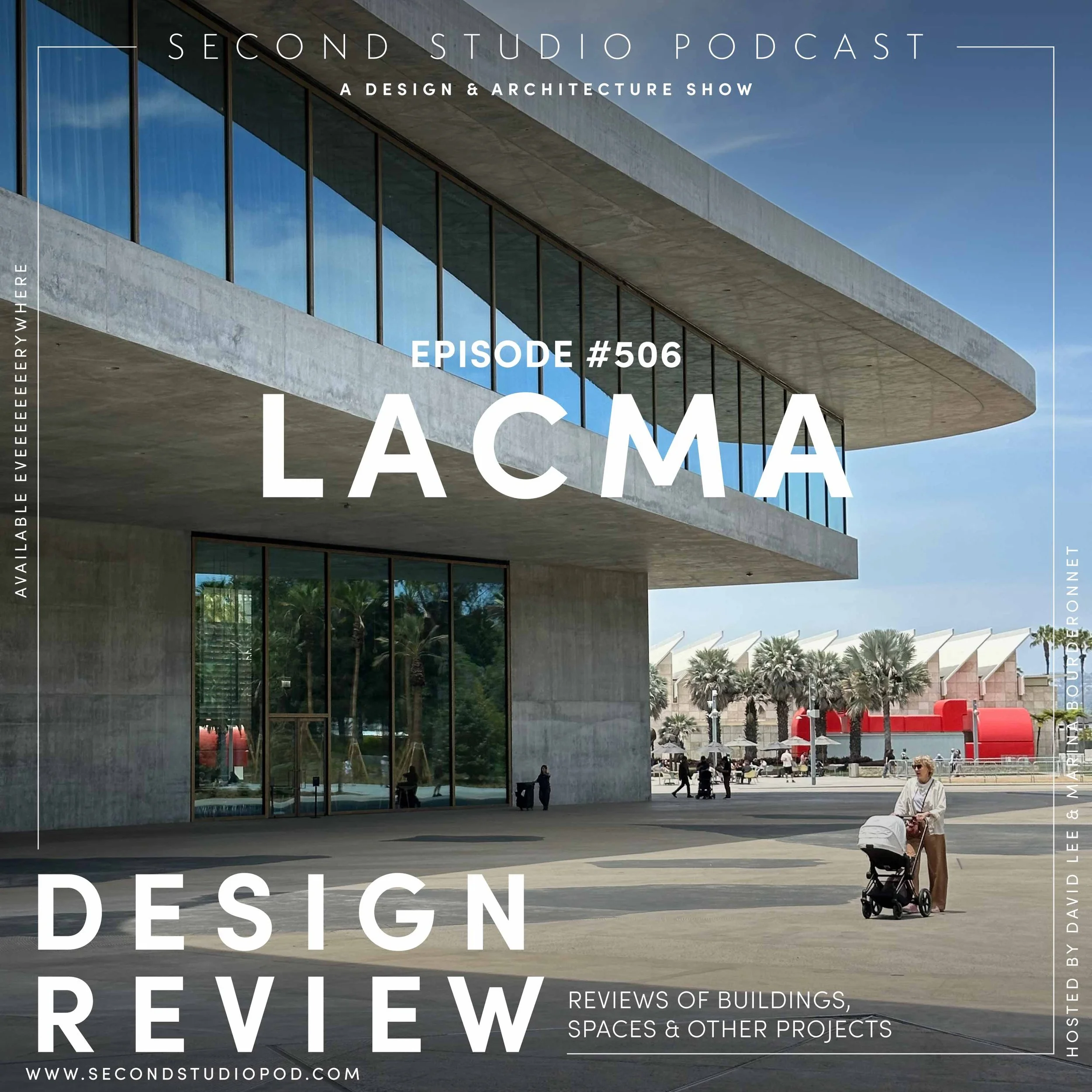
#506 - LACMA BY PETER ZUMTHOR
SUMMARY
This week, David and Marina of FAME Architecture & Design review the Los Angeles County Museum of Art (LACMA). The two discussed LACMA’s entry & exterior, the interior design, external experience of LACMA, materiality, inside-outside connection, dark interior & psychological impact, building details, artwork display, open plan design, food options, architectural forms, and more. Enjoy!









TIMESTAMPS
(00:41) LACMA’s entry & exterior.
(07:53) Interior design.
“When I say I love the interior space [of LACMA], it doesn't mean that I'm putting Peter Zumthor on a pedestal because I've seen this before conceptually. What I love is that the concept was realised. To be able to experience a space like this, a conceptual architecture closely made to reality, and it produces the effects that we think it should. So to me, it's proof that a concept can have the impact that we want it to. If more people would just allow us architects to do that, we could produce more things that feel as good as this.” (14:18)
(15:57) External experience of LACMA.
(24:39) Materiality in LACMA
(28:18) Inside-outside connection.
“[LACMA has] this fusion of different things that you typically don't experience together. I think that's what architecture is supposed to do. It's supposed to create an environment where you are experiencing familiar things and new things, but all mixed up together, and they're just framed in a different way than what we see all the time. I think this is doing that.” (29:29)
(30:40) Dark interior & psychological impact.
(34:41) Building details.
“One of the things that architects and clients default to, is as much glass as possible, and as little frame as possible. They’d rather have the biggest piece of glass possible with butt joints and no frame. I get it. But window frames and mullions can really provide a sense of scale, datum and a reference point to make something more magical. It's a fallacy to think that pure glass automatically equals more connection to the outside, and automatically means a better view or experience. It's absolutely not the case.” (34:57)
(39:14) Artwork display.
(43:45) Open Plan.
(47:04) Food options.
(54:02) Architecture forms.
“Peter Zumthor had said that the geometry of [LACMA’s] plan was not something that he decided it to be. He wanted the building to perform in a certain way and to achieve certain things, and that was the best geometry for it, which is honest. As opposed to architects who have a formal agenda and that's all they're going to do regardless of anything else. They rationalize it through some bullshit, like, “Oh, it's like nature or whatever.” That’s nonsense.” (54:27)
“The argument that architecture mimics the forms of nature is such horseshit. Can we stop with that? It's like saying, “You feel a certain way when you're in nature, right? You feel good. Well, there's certain things that make you feel that way. And we're taking out those things and putting that into the buildings, and therefore the building is validated and you feel better because of that.” I disagree with that because depending on how you define people and nature, we exist as a species, a part of nature, but we're also very different from everything else in nature. A part of what it means to be human is this conflict. To not embrace the conflict, which is to say, to be open to other forms, geometries, colors, materials, etc., and to acknowledge that the nature of what we're doing is to wrestle with this conflict, it's a lie.” (55:05)
HAVE QUESTIONS OR SUGGESTIONS?
TEXT/CALL OUR HOTLINE
213-222-6950



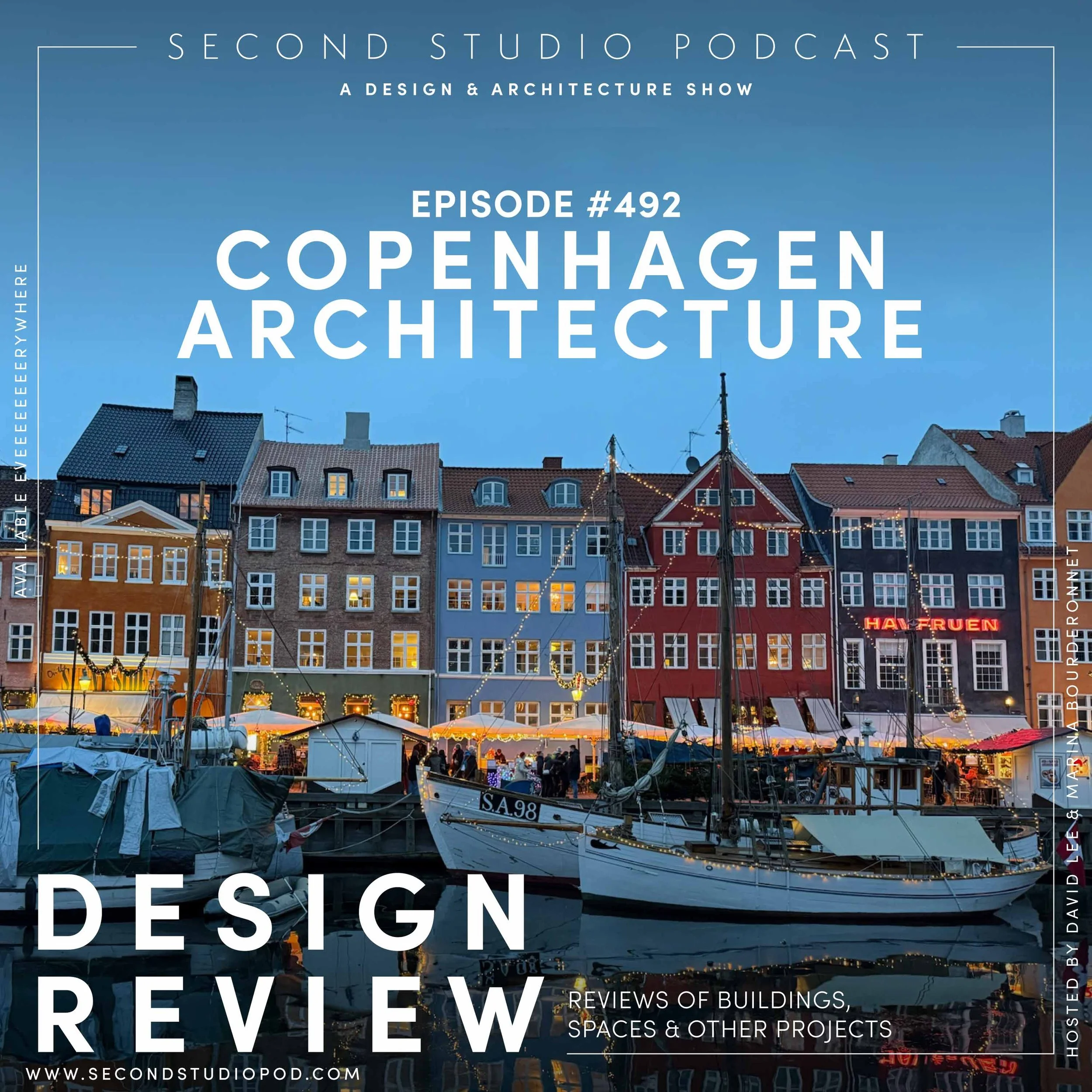
#492 - COPENHAGEN ARCHITECTURE: OMA, Jørn Utzon, BIG, and more
SUMMARY
This week, David and Marina of FAME Architecture & Design review the architecture of Copenhagen. They discussed local apartment developments, modern and old neighborhoods, infrastructure & civic design, facade design, building details, Blox building by OMA, the Bagsværd Church by Jørn Utzon, BIG’s 8 House, The Mountain, and VM Houses, the Black Diamond building, the Grundtvig Church, and more. Enjoy!
TIMESTAMPS
(01:41) Copenhagen apartment design.
“The area where most architects fail is the outdoor space. It drives me nuts because arguably the most important part about creating a community is that negative space, the public space to share experience. I think it points to when you have 3 or 4 different developers on a giant lot with each doing their own building, who is the person and the trade that ties it all together? Everyone wants to buy a piece of land and build their thing, but no one wants to spend the time or money to hire a coordinator to make sure that the whole neighborhood actually works together.” (07:00)
(07:49) Modern vs old neighbourhood design.
“The reason why a lot of people dislike modern architecture is, I think, partly valid, and it's the lack of decoration. More specifically, it's a lack of depth, texture, and soul to the building. When you have a building that's mostly flat with just punched openings, it's minimal, and it's hard to feel comfortable at all. Most historical buildings in historical districts have this layer of decoration or ornamentation, and it just helps everyone feel like they're more connected to the environment.” (12:15)
“A lot of contemporary work focuses too much on the form of things and how it looks as a decorative sculpture rather than thinking about the experience that the structure is creating for people. I don't mean experience as in experiencing the structural gymnastics of the building. I mean the experience that the architecture is framing or outlining to take place. It goes back to the idea of architecture as a stage or a platform of sorts. I feel like a lot of contemporary work needs to think more about that.” (21:54)
(23:09) Subway station wayfinding.
(25:38) Infrastructure & civic design.
“This is the type of thing where someone's at a lecture hall [giving a super cool presentation of the project’s concept & diagram], but when you go there, there's nothing amazing about the aesthetics, which is the majority of how we experience things. There is this weird thing in contemporary architecture where we all get super jazzed up about the concept of something, and diagrams with lines that don't exist in real life. Meanwhile, the actual thing in real life is almost nothing because it doesn't present anything of aesthetic or experiential, spatial value.” (28:44)
(36:18) Random patterns on buildings.
(40:53) Modern & historic buildings juxtaposition.
(46:15) Markets & Amusement Park.
“It's almost like when we design cities, we don't dream enough. All of the stuff you would want in a city was in this amusement park, but in some parts of the city, you couldn't even get to that level. I think it goes back to the conversation about zoning regulations and codes, etc. We collectively just follow the rules too much and forget about the fun.” (48:33)
(50:13) Execution of building details.
(55:31) Blox building OMA.
(01:01:10) Churches in Copenhagen.
“An aspect of what makes some architecture so amazing is the abandonment of being so conservative and stingy with space. How much of the built environment has to be efficient with space? I know that sounds crazy, like why would you not be efficient with space? That's because you should use space for quality. You shouldn't use space just for dollar signs.” (01:04:30)
(01:13:00) BIG Projects.
(01:24:04) Black Diamond Building.
(01:26:54) Grundtvig Church.
HAVE QUESTIONS OR SUGGESTIONS?
TEXT/CALL OUR HOTLINE
213-222-6950

#319 - DESIGN REVIEW OF BIG'S GOOGLE HEADQUARTERS AND GINGERBREAD HOUSE IDEAS
SUMMARY
This week David and Marina have a casual chat about Google's Headquarters designed by BIG and Heatherwick, gingerbread house ideas, weddings, over-documenting life, and more! Enjoy
