
#470 - PACIFIC PALISADES FIRE REBUILD UPDATES
SUMMARY
This week, David and Marina of FAME Architecture & Design share updates on the Pacific Palisades fire rebuild efforts. They discuss the lack of centralized information on the Palisades fire, common questions from fire victims, educating clients to make the right decision, like for like regulation updates, rebuilding without previous house plans, house footprint location & areas calculation, tax implications, finding a contractor for fire rebuilds, construction price discrepancies, and prefab housing. Enjoy!







TIMESTAMPS
(00:00) Lack of centralized information on the Palisades fire.
(05:36) Common questions from fire victims.
(14:00) Educating clients to make the right decision.
“Construction cost per square foot is a piece of information that is oftentimes easily misleading. As a resident, it's very easy to have a quick conversation with my neighbor, who tells me, “Our construction cost was $550ft².” So now I think, “Well, someone said 550ft².” What's missing from that number is the schedule, design quality, and the type of contractor–are they a spec builder contractor that takes all kinds of shortcuts on the inside of walls?, material quality, and execution level” (14:48)
(18:55) Like-for-like regulation updates.
“In the like-for-like type of project, previously, it meant you could build 110% of the previous square footage. Now, the rules for like-for-like projects have nothing to do directly with the total square footage limitation of the house. The like-for-like parameters only specify a maximum allowable size of the footprint of the building and the height. Within that bubble, you can do whatever you want.” (20:35)
(25:09) Rebuilding without a previous house plan.
(29:51) House footprint location & area calculation.
“In the like-for-like project, the shape [of the house] can be anything you want, which is very freeing. You can also move the location of the house pretty drastically–by up to 20% of the property width and the depth. So, if we have a rectangular lot that's 50 by 100ft. That means wherever your house was previously located, it can move front to back by 20ft and side-to-side by 10ft.” (30:11)
(33:48) Tax implications.
“The permitting approvals timeline difference between like-for-like and new construction in a non-coastal area is basically identical. So then why would you not just do a new construction? My understanding is that when you exceed the previous square footage, you get taxed differently. If you're doing a like-for-like rebuild, the first 100% of the square footage you build back gets taxed the same as before; it doesn't change. The additional 10% you're doing gets taxed at a higher rate, but not the rate of a new construction project. When you go beyond that and you are doing a new construction, the property gets reassessed, and now you're taxed much higher.” (34:21)
(35:39) Finding a contractor for fire rebuild.
“Broadly speaking, if you are under pressure where you have a tight budget, a tight schedule, and those are immovable, there's a good argument that that is not the type of situation for experimentation. Obviously, everyone's concerned with fire resiliency, and there are more fire-resistant methods of fabricating a house that are not common. Of course, if you go and you talk to those businesses, they will tell you all the great things about what they do and how it's more fire resilient. But there's like a hundred other pieces of information that dictate whether it's a good idea, and those methods oftentimes cost more money, even if they are faster in one regard, but often cause slowness in many other ways.” (45:17)
(48:12) Tips to rebuild on a tight budget.
“You're hearing from contractors who say, “I can do a high-end house for $400/ft².” Whereas other contractors who are reputable will say, “No way. It's $1000/ft² minimum for me to do anything of quality.” Why the heck would there be this massive range of costs? I think an interesting way to problem-solve that challenge is to have a few contractors give a ballpark estimate, which we would call a ROM or Rough Order of Magnitude, to rebuild your house exactly as it was before with common sense upgrades.” (49:00)
(51:21) Reason behind the big construction price discrepancy.
“As a developer, the more money I spend on construction, the less money I make. So, if I can build something that sells the same, but I can cut out $200/ft² or $300/ft², I will do that (if I were a sleazy developer). The things they cut out are sometimes things that you don't see on the outside, in the photograph, or in person. But what's behind the drywall? What's behind the wood siding? What did they use to secure the flooring? How's the framing? Oftentimes, it's the things you don't see necessarily, but should care the most about because that's what's going to make the house last, or not, over time. It is unfortunately very common for people to buy a spec house and enter a lawsuit afterward with the previous owner or the developer.” (52:30)
(01:01:17) Prefab house solutions.
HAVE QUESTIONS OR SUGGESTIONS?
TEXT/CALL OUR HOTLINE
213-222-6950



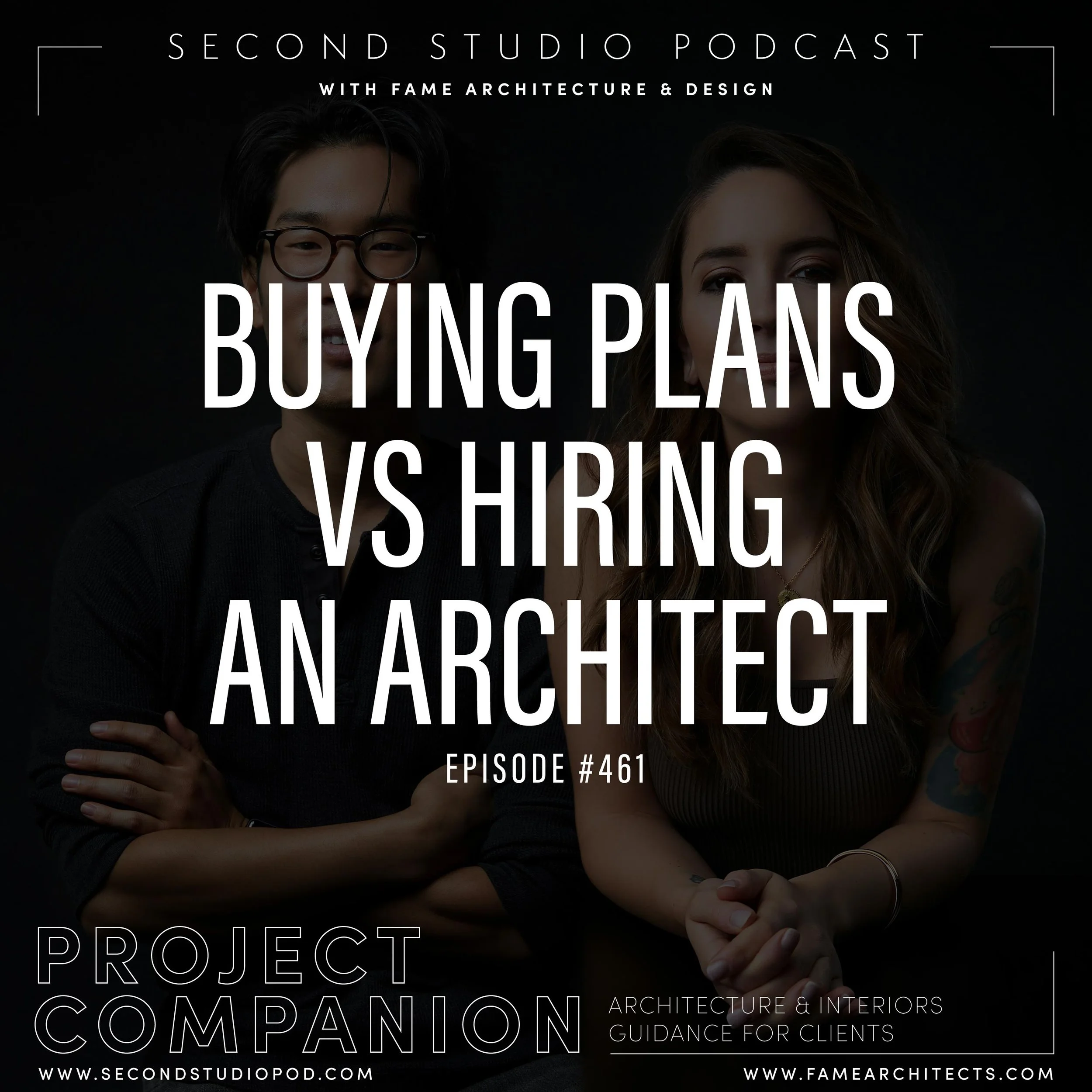
#461 - BUYING PLANS ONLINE VS HIRING AN ARCHITECT
SUMMARY
This week David and Marina of FAME Architecture & Design discuss the difference between buying online plans vs hiring architects. They touched on why architects produce more drawings, clients don’t understand hierarchy of information and phases, pre-fabricated homes vs pre-designed floor plans, how to save money on a tight budget, clients need to know their budget, construction cost isn’t everything, accessibility of building quality homes, difference between The Shift House and generic floor plans, and more. Enjoy!
TIMESTAMPS
(00:00) Comparing architects to generic plans website
(08:15) Why architects produce more drawings.
“The word plan is too vague. Anytime I'm talking to a prospective client and they have a set of plans from someone else, I want to see what they got. Because are they conceptual design plans, schematic design plans, design development plans, permit drawings or construction documents? These are completely different beasts, not even close to being the same thing. Most often, when clients get plans or construction documents at a discount, what they're getting is conceptual plans, which is the lowest form of plans. They're not getting the rest of the information needed for the project.” (15:11)
(18:19) Clients don’t understand hierarchy of information and phases.
“Oftentimes, when I'm talking to the public or new clients, they come at me with a bunch of information, which is great. I love information, but I have to order it and tell them [the hierarchy of importance and the timeline where each phase comes in.] If there are contractors asking clients to start work that’s 6 months down the track, they can tell them to talk to the architect instead, which is what they should be doing. That's one of the most underrated values of hiring an architect early is using them as a resource to understand all this data that you're being hit with as a client. You just don't know if something is right or wrong, important or not important.” (24:21)
(26:29) Prefab homes vs pre-designed floor plans.
(33:34) How to save money on a tight budget.
“The way that we [architects] keep projects on schedule and within budget is by making sure that the professionals we've hired are providing the services they are responsible for at each phase of the project. You can't do that if you're hiring an architect who's a third of the typical price. It's not possible. It's a quantifiable difference because you are getting less services. They're not going to help you ensure that the contractors are hitting those marks. Why would they do 100% of the work for 50% of the fee? Unless they just love losing money. It means there are work that will not be provided for that price, and you need to understand what that is.” (37:38)
(41:23) Clients need to know their budget.
(46:39) Out of state contractors for fire rebuild.
(49:53) Construction cost is not everything.
“One of the mistakes that clients make when they're embarking on a project is they focus too much on the construction cost. The construction cost is important, but it’s [only a portion of] the total project cost. This is where clients run into problems, because they think that the construction cost is the total budget for the project when that's not true. Let's say a client comes and say, “I have $1 million to build.” Well, you actually have less than $1 million budget for construction because that is your total budget for the project.” (50:00)
(54:45) Accessibility of building quality homes.
(01:01:04) Difference between The Shift House and generic floor plans.
“I have spoken to a couple of developers who are interested in working with us. Developers are very budget conscious and understandably so. A lot of architects don't like working with developers because they're just constantly trying to cut down on cost. With that said, developers are very interested in what we've done with The Shift House and they see great value in it. In a certain way, that sort of proof that what's being offered is of significant value because it's being vetted by people whose livelihood is to build things in an efficient manner, to make money. And they understand that they need quality services to get that done.” (01:02:55)
HAVE QUESTIONS OR SUGGESTIONS?
TEXT/CALL OUR HOTLINE
213-222-6950

#457 - The Shift House: A Pre-Designed Pacific Palisades Fire-Rebuild Home
SUMMARY
This week David and Marina of FAME Architecture & Design discuss The Shift House, their pre-designed model home for the Pacific Palisades. They cover the purpose of The Shift House, conceptual thinking, site planning, form and massing, indoor/outdoor connections, procession & privacy, optionality, material palettes, fire resiliency, and more. Enjoy!
Visit: https://www.famearchitects.com/shift-house-case-study-2
Contact: info@famearchitects.com
TIMESTAMPS
(00:00) Introduction.
(10:54) Design Approach.
(15:50) Site Planning & Indoor/Outdoor Connections.
(26:38) Entry & Privacy.
(34:07) Facade Design.
(37:48) Living Room & Mezzanine Space.
(44:04) Kitchen & Dining.
(47:39) Office.
(52:11) Second Floor Plan.
(56:29) Optionality & Material Palette.
(01:10:02) Design Process.
(01:17:18) Fire Resiliency.
(01:23:23) Closing Remarks
HAVE QUESTIONS OR SUGGESTIONS?
TEXT/CALL OUR HOTLINE
213-222-6950

#449 - YOU NEED CONSTRUCTION ADMINISTRATION
SUMMARY
This week David and Marina of FAME Architecture & Design discuss the importance of Construction Administration to achieve a successful project. They touched on what is construction administration, the role of an architect during CA; why CA matters for clients; how CA saves time and money; real world scenarios during CA; what construction administration is not; questions to ask architect about CA; collaboration between architect and contractor; and more. Enjoy!
TIMESTAMPS
(00:00) What is Construction Administration?
(07:11) Role of Architect during CA.
(12:48) Construction Documents vs Shop Drawings.
(18:07) Pay application & change order.
(22:19) Manage design adjustments.
(25:19) Punch list final review.
(32:01) Why architects are important in construction Administration.
(41:46) Real-life issues during CA.
(47:07) What CA is not.
(53:29) CA is not optional.
(57:05) CA Architect & contractor mutual relationship.
(01:03:00) CA is an important phase.